
Dan thé Parkinsonian

Hello. It’s me Dan the Parkinsonian. Yes, the one who walks while whistling, even when my legs protest, even when gravity decides to have a little fun with me. It’s been seventeen years now that I’ve been living with Parkinson’s. Seventeen years of negotiating with a stubborn body, taming movements that have a mind of their own, learning that slowness can also be a way of moving forward. But let’s be clear: the story you’re about to read isn’t a medical journal. Nor is it a tragic testimony. Dan’s story, though based on real events, is told here in a caricatural way. Because sometimes, to tell the truth, you have to exaggerate a little. Because humor opens doors that seriousness closes. Because life — even when it trembles — can still be funny, especially when a little squirrel joins the scene.
That squirrel is my conscience, my mirror, my coach, my mischief‑maker. He says out loud what I think quietly. He exaggerates, he comments, he gets things wrong… but he’s always by my side. And since he’s part of the story, let me introduce him: his name is Jean Noisette. And I should add this: this book is the result of a close collaboration between IN and AI — between natural intelligence and artificial intelligence. Between living thought and assisted thought. Between a man who trembles and a machine that doesn’t. Together, we’ve tried to tell fragility with clarity, and illness with humor. This book isn’t a technological demonstration. It’s a conversation.
An unlikely alliance between flesh and code, between memory and logic, between laughter and syntax. And if this encounter helps people better understand what it means to live with Parkinson’s, then it will have served its purpose. Make yourself comfortable. Let’s begin.

Dan the Parkinsonian — the man who tries to be ill without making an illness of it
How to Read This Book. Before diving into the episodes, I want to explain how this book is built. Each chapter follows the same path: simple, human, and true to the way I move through life — one step, one observation, one adaptation. Each episode begins with an anecdote inspired by real events. A moment that happened to me — sometimes ordinary, sometimes unsettling, but always revealing. These anecdotes aren’t just there to entertain, though some will make you smile. They serve as entry points: precise moments when something shifts, when the body speaks, when life forces me to look differently. Then comes the lesson I drew from it. Not a moral, not a theory.
Just what I understood — sometimes right away, sometimes years later. After that, I explain how I actually deal with that situation in daily life. The strategies I’ve developed, the adjustments, the trials, the errors, the discoveries. It’s the most concrete part: what I do, what I change, what I learn as I walk.
Finally, I share the results I get. Not miracles, not perfect solutions. Human results — measurable, sometimes surprising, sometimes modest, but always real. That’s how this book moves forward: an anecdote, a lesson, a method, a result. And me, moving along with it. The images that accompany this book aren’t just illustrations. They extend the story, give faces to the scenes, amplify the humor, tenderness, or absurdity of the moment.
They’re part of the deliberate caricature of my world — a world where a squirrel can comment on my steps and where illness becomes a supporting character rather than a tyrant. Each image is designed as a breath, a wink, a different way of seeing what the words already tell. They don’t aim to represent reality, but to reveal its spirit.
And Why Humour? I’ve dedicated a full episode to that question. For now, here are two sayings that capture the heart of it: “It’s not funny just because we laugh at it.” “And laughing about it doesn’t mean we’re not taking it seriously.”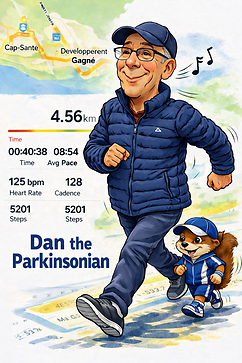
Join the conversation